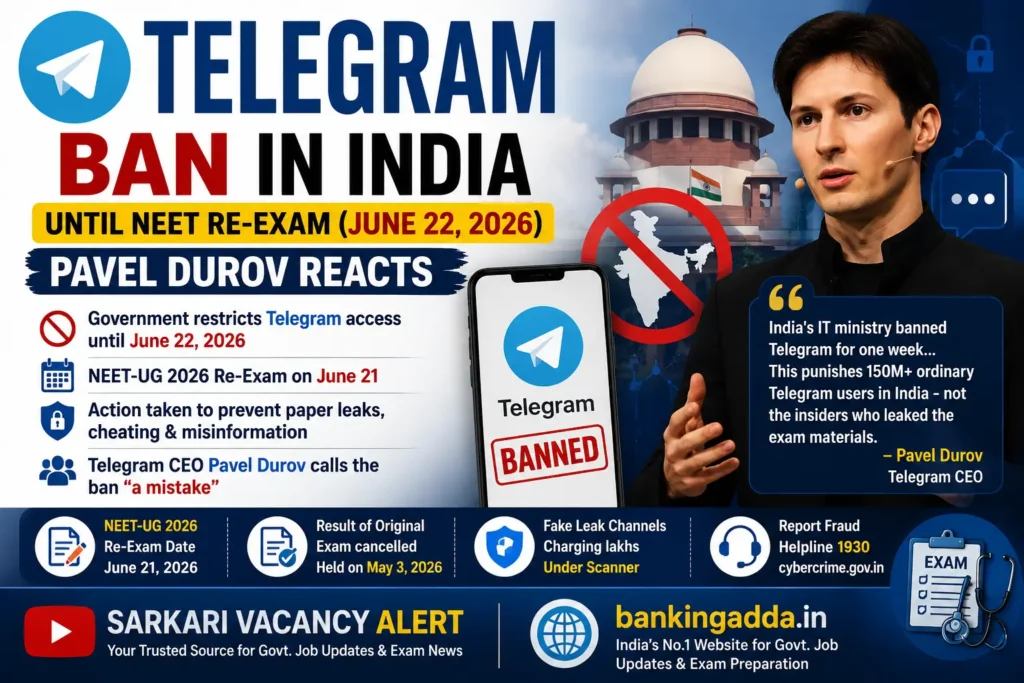

Telegram: Messaging platform Telegram has found itself at the center of a major controversy after the Indian government temporarily restricted access to the app ahead of the NEET UG 2026 re-examination. The move, which remains effective until June 22, 2026, was implemented following recommendations from the National Testing Agency (NTA) to prevent cheating, misinformation, and fake paper leak claims surrounding the high-stakes medical entrance examination.

The decision has triggered widespread debate across the country, with Telegram founder and CEO Pavel Durov strongly criticizing the ban and arguing that it unfairly affects millions of legitimate users while failing to address the root cause of exam-related leaks and scams.
Telegram Temporarily Restricted in India
The Government of India imposed a temporary restriction on Telegram ahead of the NEET UG 2026 re-examination scheduled for June 21. The measure was reportedly taken under Section 69A of the Information Technology Act, 2000, with the objective of curbing misinformation campaigns, fake paper leak claims, and organized cheating networks operating through various channels on the platform.
The restriction covers the examination period and the immediate aftermath, with authorities aiming to ensure a fair and transparent conduct of the re-test.
The move follows months of concerns surrounding alleged irregularities in NEET UG 2026 and growing anxiety among students due to misleading claims circulating on social media platforms.
Pavel Durov Reacts to the Ban
Telegram CEO Pavel Durov publicly criticized the Indian government’s decision through social media posts, stating that the temporary restriction impacts more than 150 million users in India who use the platform for legitimate communication purposes.
According to Durov, banning the platform does not eliminate the problem of leaked content but merely shifts such activities to alternative communication channels.
He emphasized that Telegram had already taken significant action against channels involved in sharing purported leaked examination materials and scams.
Durov also highlighted recent platform updates designed to increase transparency and reduce misuse of editing features that could be exploited to create misleading evidence of paper leaks.
Why Did NTA Recommend Restrictions on Telegram?
The National Testing Agency stated that the decision was aimed at preventing malpractice and misinformation before the NEET UG 2026 re-examination.
According to NTA officials, there was no fresh confirmed paper leak that directly triggered the action. Instead, authorities were concerned about fake messages, fabricated leak claims, and fraudulent channels exploiting students and parents.
NTA Director General Abhishek Singh stated that authorities were taking all necessary measures to ensure that the re-examination is conducted fairly and without any malpractice.
The Controversial Message Editing Feature
One of the key concerns raised by authorities involved Telegram’s message-editing functionality.
According to NTA, some channel administrators allegedly exploited the feature by editing older posts and replacing attached files while maintaining the original timestamp. This created the impression that examination papers had been shared before the actual examination.
Authorities argued that screenshots of such edited posts were being circulated as false proof of paper leaks, creating panic among candidates.
As part of the government’s directives, Telegram was reportedly instructed to disable editing functionality for previously posted messages in India until June 30, 2026.
Fake NEET Leak Channels Under Scanner
Investigators identified several channels that were allegedly claiming access to leaked NEET question papers and demanding payments from students.
Some reported channel names included:
- PAPER LEAKED NEET
- Re-NEET 2026
- Private Mafia
- REE NEET MAFIAA
Authorities stated that such channels were charging amounts ranging from a few thousand rupees to several lakh rupees in exchange for purported access to examination papers.
The NTA reiterated that genuine examination papers remain secured within the official examination process and that any claims of guaranteed access are fraudulent.
Cyber Crime Agencies Already Took Action
Before imposing platform-level restrictions, law enforcement agencies had already initiated action against multiple groups and channels.
The Indian Cyber Crime Coordination Centre (I4C), operating under the Ministry of Home Affairs, worked with police departments in Bihar, Gujarat, Rajasthan, and other states to identify and remove several suspicious channels, bots, and groups involved in spreading misleading information.
Officials described the temporary platform restriction as a last-resort measure after other interventions failed to fully contain the problem.
NEET UG 2026 Re-Examination Scheduled for June 21
The controversy comes in the backdrop of the NEET UG 2026 re-examination.
The original examination conducted on May 3, 2026, was cancelled following allegations of irregularities and malpractice. As a result, affected candidates will now appear for the re-examination on June 21.
NTA has urged students to rely only on official notifications and information published through authorized government channels.
Candidates have also been advised to report suspicious messages and fraud attempts through:
- National Cyber Crime Helpline (1930)
- Official cyber crime reporting portal
- NTA helpdesk services
Internet Freedom Groups Criticize the Decision
The temporary restriction has drawn criticism from digital rights advocates and internet freedom organizations.
The Internet Freedom Foundation (IFF) described the action as disproportionate and argued that blocking an entire platform due to the actions of a small number of users raises concerns regarding freedom of expression and access to communication services.
According to critics, targeted enforcement against offenders may be more effective than imposing restrictions affecting millions of users.
Cybersecurity Experts Question Effectiveness
Several cybersecurity experts have also questioned whether blocking Telegram can effectively stop the circulation of misinformation.
Some experts pointed out that users can potentially migrate to alternative messaging applications, proxy services, or other communication platforms.
Others argued that the underlying issue is not limited to any single platform but involves broader challenges related to online misinformation and examination fraud.
IIT Kanpur Director Explains the Concern
Commenting on the issue, IIT Kanpur Director Manindra Agrawal explained that the concern was not limited to actual paper leaks but also involved the creation of misleading evidence through platform features.
He noted that certain editing capabilities could allow older posts to appear unchanged despite content modifications, potentially creating confusion among students and the public.
According to him, such misuse of technology can significantly amplify misinformation during sensitive examination periods.
Students and Social Media Users React
The restriction has generated intense discussion across social media.
Many users supported the government’s efforts to ensure a fair examination process, while others argued that restricting access to a major communication platform was excessive.
Students preparing for competitive examinations expressed concerns about losing access to educational groups, study material channels, and communication networks that they regularly use for academic purposes.
The debate has once again highlighted the challenge of balancing examination security, digital freedoms, and platform accountability.